Network Architecture Guide

HTTP vs SOCKS5 vs VLESS vs OpenVPN vs WireGuard

Each proxy and VPN protocol operates at a different OSI layer with distinct trade-offs between application isolation, encryption overhead, anti-DPI behavior, and antidetect browser compatibility. Here is the technical breakdown.

Comparison Matrix Interactive Protocol Wizard
Interactive Guide

Protocol Selection Assistant

Select your primary application use case to determine the optimal protocol layer.

Recommended Solution

SOCKS5 Proxy (100% Sufficient & Recommended)

SOCKS5 with UDP enabled is 100% sufficient and ideal for all antidetect browsers. You DO NOT need VLESS for standard multi-accounting.

Without UDP enabled on the proxy server, Chromium WebRTC requests require setting browser WebRTC to Altered / Replace mode.

  • Risk: WebRTC UDP Real IP leak on target sites (Browserleaks, Facebook, Ebay)
    Fix: Enable SOCKS5 UDP forwarding on your proxy server / VPS, and set browser WebRTC to "Altered / Replace" mode (emulating your mobile SIM IP).
  • Risk: QUIC (HTTP/3) fallback exposing direct local ISP connection
    Fix: Launch browser profiles with --disable-quic flag or enable UDP forwarding.
  • Risk: Local ISP or network firewall blocking proxy ports (Rare Edge Case)
    Fix: VLESS is ONLY needed if your ISP or country actively blocks standard SOCKS5 ports (e.g. strict firewall rules). Otherwise, SOCKS5 is completely sufficient.

Use SOCKS5 + WebRTC = Altered/Replace and --disable-quic. No complex VLESS setup required.

Protocol Technical Matrix

Side-by-side comparison across 8 core networking dimensions.

Dimension HTTP / HTTPS SOCKS5 VLESS (Xray) OpenVPN WireGuard
OSI Layer Layer 7 (Application) Layer 5 (Session) Layer 7 Encrypted Tunnel Layer 3/4 TUN/TAP Card Layer 3 Kernel Adapter
Target Software Python scripts, Curl, Proxy Extensions AdsPower, GoLogin, Multilogin, Telegram v2rayN, NekoBox, Xray Sidecar OpenVPN Client, Router Firmware WireGuard App, OS Kernel Adapter
Encryption Optional TLS Plaintext TLS 1.3 / REALITY OpenSSL AES-256 ChaCha20-Poly1305
UDP & QUIC TCP Only Supported, Chrome drops Native Full UDP Full UDP (Layer 3) Full UDP (Layer 3)
Anti-DPI Protection Low Plaintext Headers High (HTTPS Mask) Moderate Detectable Port
Antidetect Native Yes Yes Via Xray Sidecar Via OS Client Via OS Client
Profile Isolation Unlimited IPs Unlimited IPs Unlimited IPs 1 System Gateway IP 1 System Gateway IP
XProxy Primary Use Web Crawling Antidetect Profiles Anti-DPI UDP Tunnels Enterprise Network Full System Tunnel

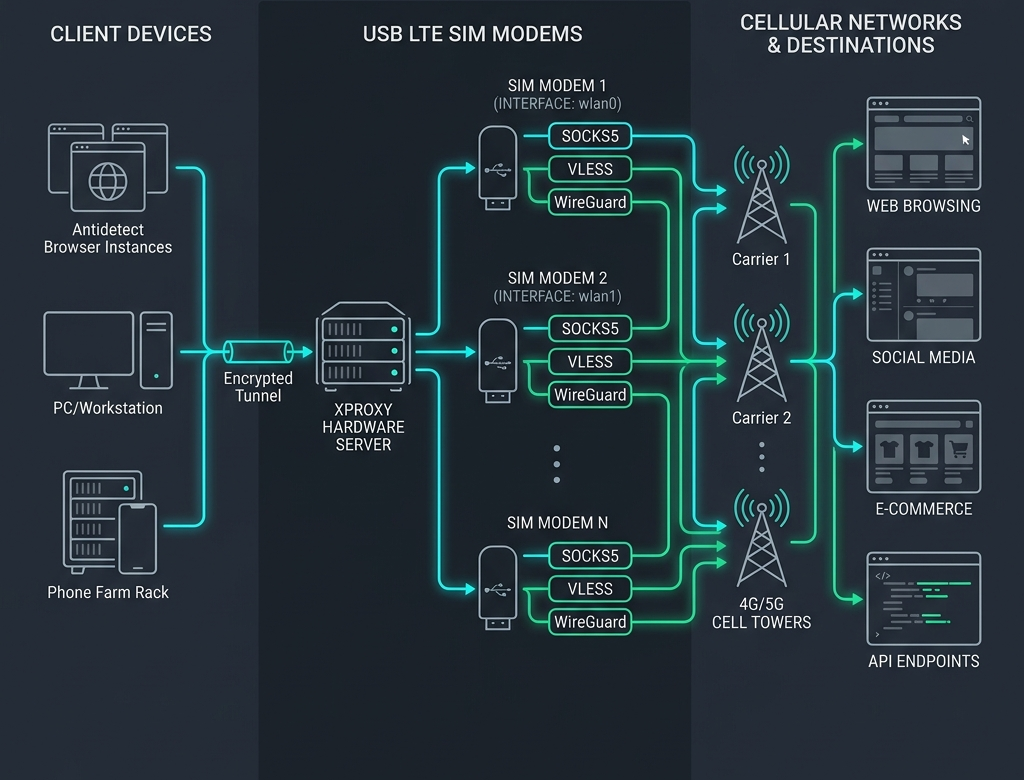
How It Works: Hardware Routing & Per-SIM Modem Protocols

XProxy provisions dedicated protocol endpoints per 4G/5G SIM modem interface out-of-the-box. Each modem plugged into XProxy gets its own isolated SOCKS5 port, VLESS UUID endpoint, and WireGuard TUN configuration, ensuring clean IP isolation per modem.

How XProxy Hardware Server Routes SOCKS5 VLESS WireGuard Per 4G 5G SIM Modem Interface Diagram

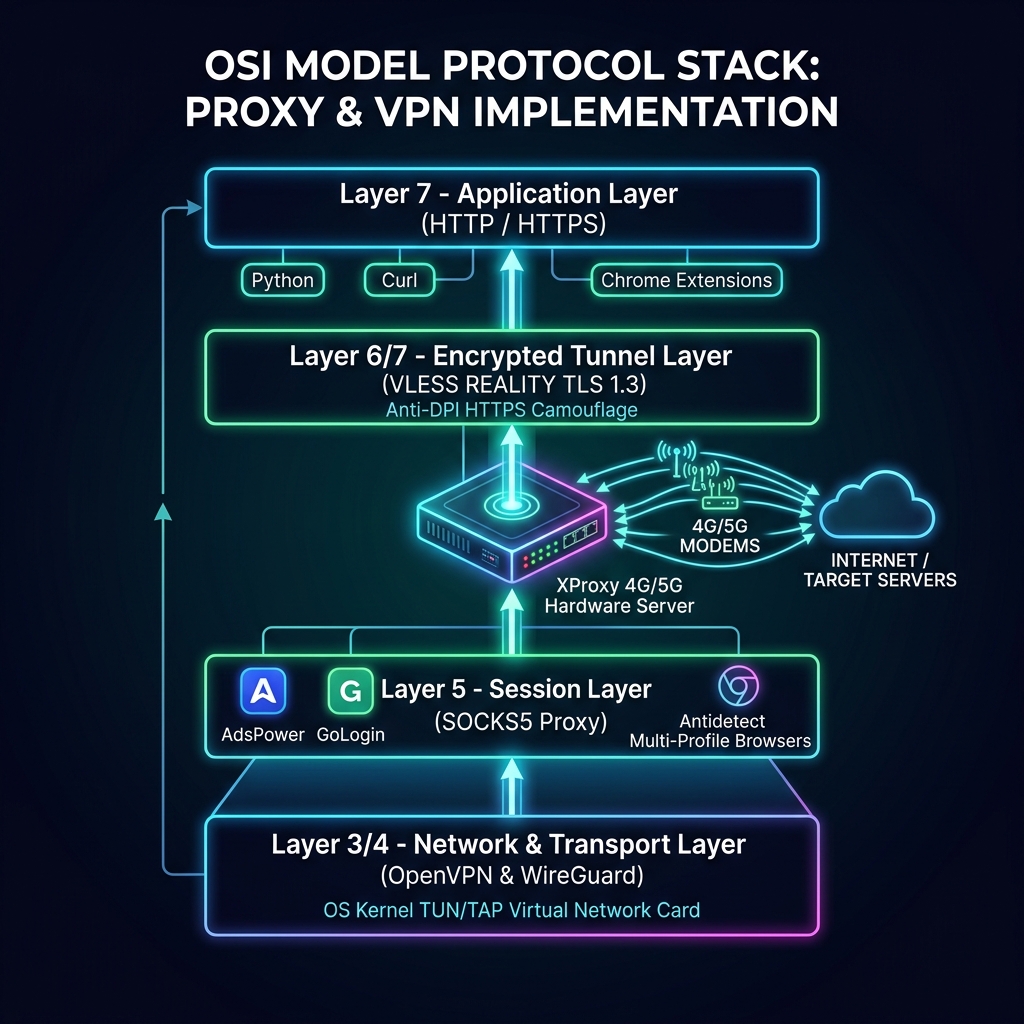
OSI 7-Layer Protocol Architecture

Visual representation of protocol operating layers (Application L7, Session L5, Encrypted Tunnel L7, Network L3/L4).

OSI 7-Layer Network Architecture for HTTP SOCKS5 VLESS OpenVPN WireGuard

Architectural Selection Framework

Technical guide for matching application requirements to the appropriate protocol layer.

Technical Reference
Layer 7 Application Lightweight
HTTP / HTTPS Proxy

Application-layer proxy. Lowest CPU and memory footprint for web crawlers and HTTP automation scripts.

Target Stack: Python (requests, scrapy), curl, Proxy extensions.
Primary Benefit: 50% lower memory usage vs browser automation; direct string authentication.
Typical Scenario: High-volume web scraping scripts parsing 50,000 product pages per hour via HTTP rotating endpoints.
Layer 5 Session Antidetect Standard
SOCKS5 Proxy

Session-layer TCP/UDP relay. Standard protocol supported natively across all antidetect browsers.

Target Stack: AdsPower, GoLogin, Multilogin, Hidemyacc, Telegram.
Primary Benefit: Profile Isolation: Concurrently run 500+ browser profiles with unique mobile SIM IPs on one machine.
Typical Scenario: Running 200 Facebook or TikTok advertising profiles concurrently in AdsPower with isolated 4G SIM IPs.
Layer 7 Encrypted Tunnel Anti-DPI Security
VLESS REALITY Protocol

Encrypted TLS 1.3 tunnel. Camouflages proxy traffic as standard HTTPS browsing to major websites.

Target Stack: Proxy resellers, Cloud VPS tunnels, Restrictive ISP environments.
Primary Benefit: SNI Camouflage: Inject SNI (e.g. www.google.com) to bypass SOCKS5 port blocks; native UDP forwarding.
Typical Scenario: Operating proxies on networks where SOCKS5 ports are blocked. VLESS REALITY presents HTTPS traffic to Google.
Layer 3/4 Network Adapter System-wide TUN
WireGuard & OpenVPN

Kernel-level virtual network adapter. Captures and routes 100% of OS network traffic automatically.

Target Stack: Online Gaming, Non-proxy desktop apps (Discord, EXEs), System-wide VPN.
Primary Benefit: Zero proxy config needed in software; captures TCP, UDP, ICMP Ping, and DNS queries.
Typical Scenario: Routing an entire PC running Windows games and non-proxy desktop tools through a 4G SIM IP via a 1-click WireGuard config.

Protocol Deep-Dive & Dashboard Setup

Technical analysis of advantages, trade-offs, and XProxy dashboard configuration options for each protocol.

Protocol 01

1. HTTP / HTTPS Proxy

HTTP proxies are Layer 7 application-level proxies designed specifically for web traffic. When using HTTPS, the HTTP CONNECT method creates an encrypted tunnel for browser traffic.

Key Advantages
  • Universal support across all programming languages (Python, Node.js, Go).
  • Minimal memory overhead for HTTP GET/POST web scraping.
  • Simple URI authentication (http://user:pass@ip:port).
Key Limitations
  • Restricted to web traffic (HTTP/HTTPS only).
  • No support for UDP datagrams or non-web applications.
  • Potential proxy header injection if proxy server is misconfigured.
Typical Use Case: Web crawlers (Python requests, scrapy), curl CLI automation, and browser extensions.

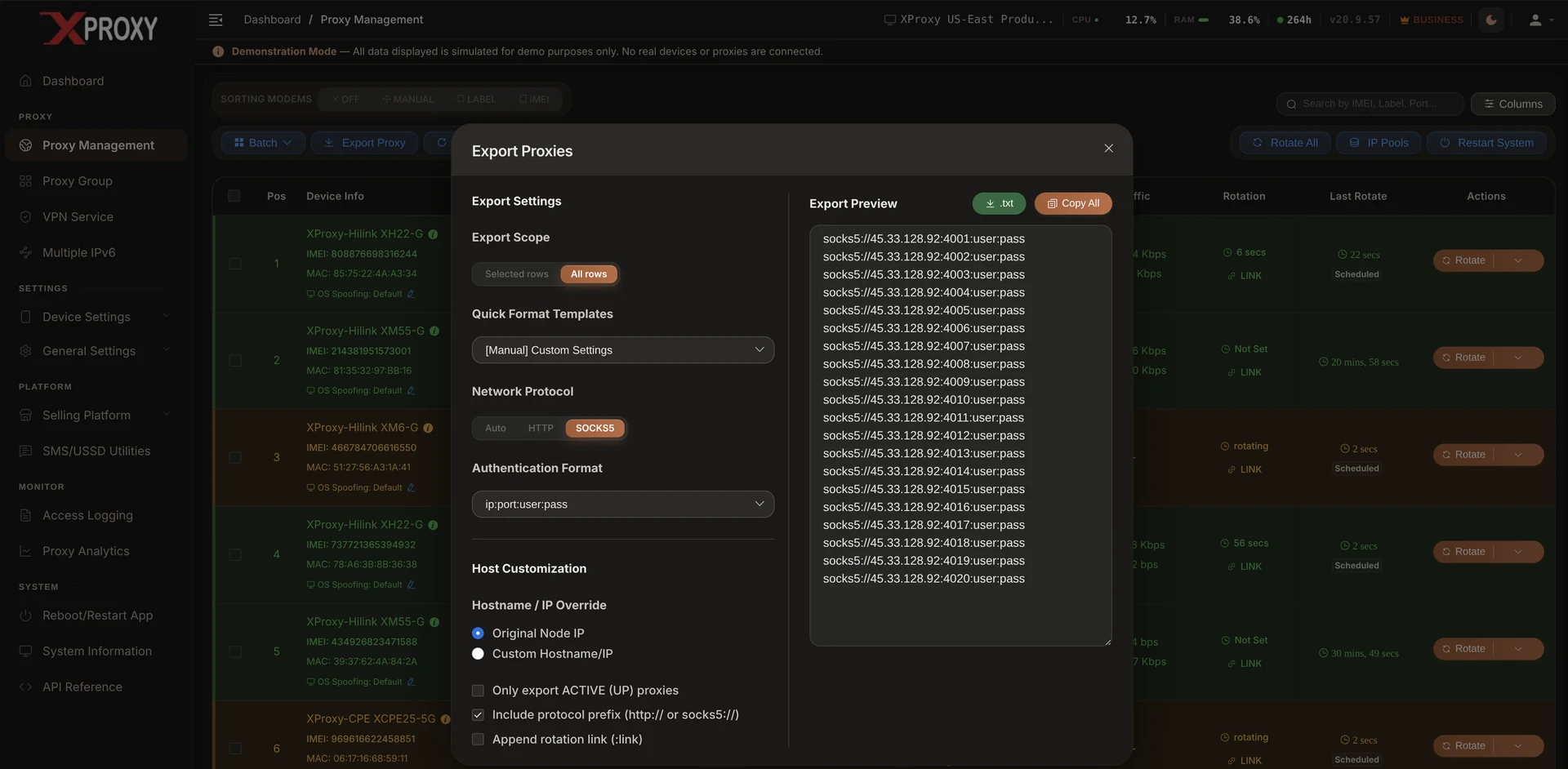
XProxy Dashboard Export Interface: HTTP Proxy Configuration
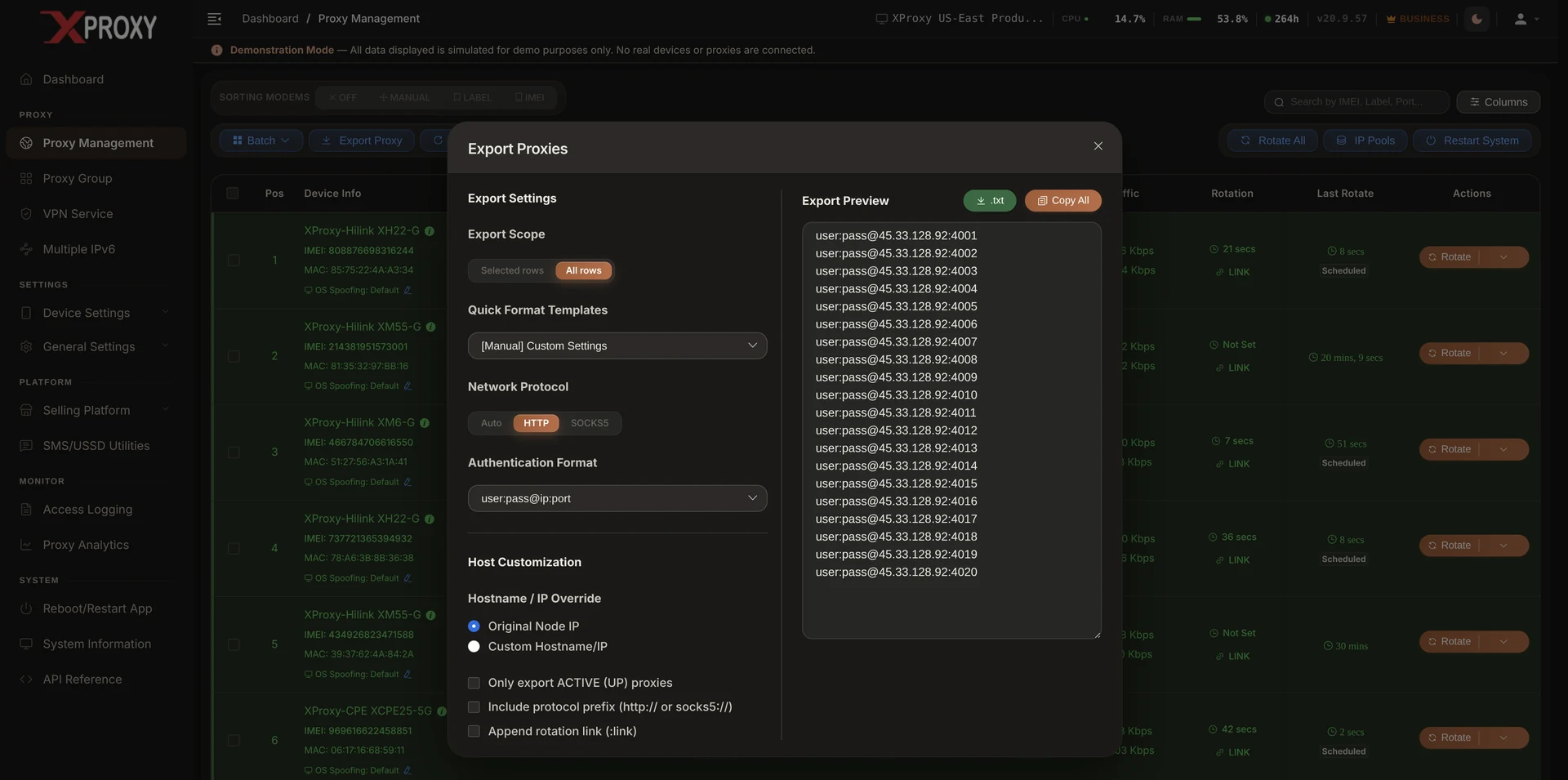
XProxy HTTP Proxy Export Interface
🖼️ [ XProxy GUI Placeholder: HTTP Export Modal ]

Admin Panel -> Proxy Management -> HTTP Export (/admin/proxies)

Protocol 02

2. SOCKS5 Proxy

SOCKS5 is a Layer 5 session-layer proxy specified in RFC 1928. It relays TCP and UDP traffic without modifying application payloads.

Key Advantages
  • Native 1-click integration in all antidetect browsers (AdsPower, GoLogin, Multilogin).
  • Per-profile IP isolation: run hundreds of browser profiles concurrently on separate SIM IPs.
  • Clean TCP payload relay with zero proxy headers.
Key Limitations
  • Unencrypted initial handshake bytes (0x05) detectable by network DPI.
  • Chromium engine omits SOCKS5 UDP ASSOCIATE (requires WebRTC Altered mode).
Typical Use Case: Multi-accounting setups in AdsPower, GoLogin, Multilogin, and Telegram Desktop.

XProxy Dashboard Export Interface: SOCKS5 & Rotation API

XProxy SOCKS5 Export Interface
🖼️ [ XProxy GUI Placeholder: SOCKS5 & Rotation API ]

Admin Panel -> Modem Proxy Settings (/admin/devices)

Protocol 03

3. VLESS Protocol (Xray Engine)

VLESS is an encrypted proxy protocol running on Xray-core. Paired with TLS 1.3 REALITY, it masks proxy traffic as standard HTTPS web browsing to major search engines.

Key Advantages
  • High anti-DPI protection using SNI camouflage (e.g. www.google.com).
  • Bypasses ISP port and protocol restrictions on corporate firewalls.
  • Native UDP encapsulation over encrypted TLS stream.
Key Limitations
  • Requires Xray client sidecar (v2rayN, NekoBox) for standard antidetect browsers.
  • Requires XProxy Business License for hardware VLESS provisioning.
Typical Use Case: Anti-DPI encrypted proxy tunnels under restrictive network gateways and proxy reselling infrastructure.

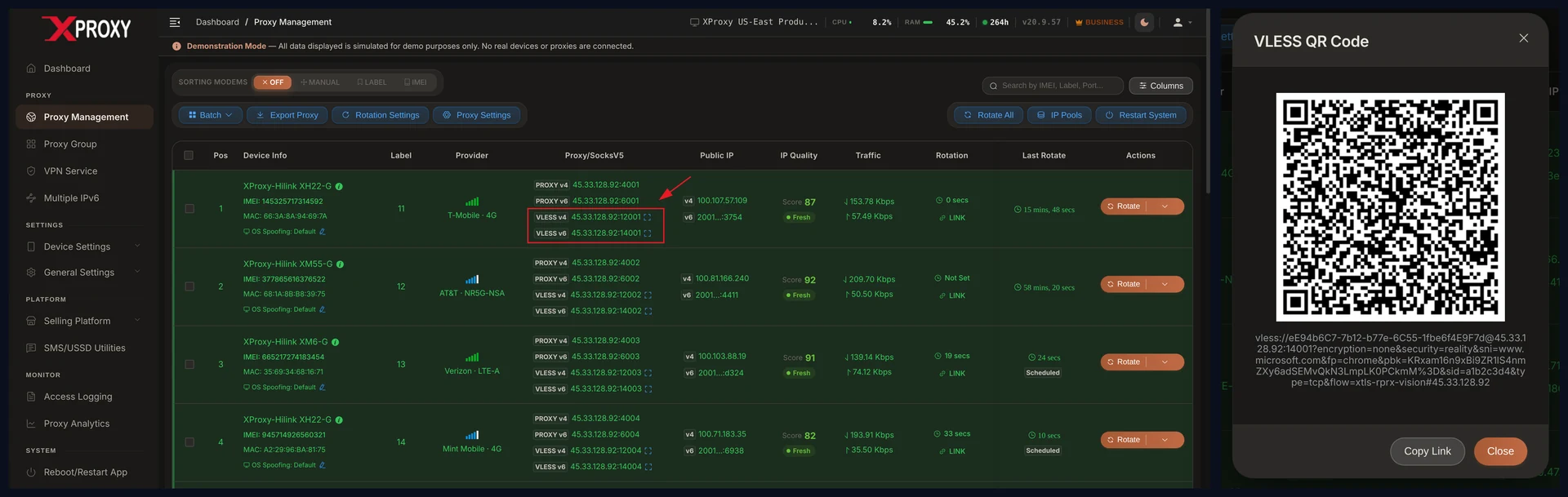
XProxy Dashboard Export Interface: Business Plan VLESS Setup

XProxy VLESS Configuration Interface
🖼️ [ XProxy GUI Placeholder: VLESS REALITY Panel ]

Admin Panel -> Business VLESS Configuration (/admin/proxies/vless)

Protocol 04

4. OpenVPN (Layer 3 TUN)

OpenVPN is an SSL/TLS VPN protocol operating at Layer 3/4. It encrypts complete system IP traffic using OpenSSL ciphers.

Key Advantages
  • Full Layer 3 virtual adapter (routes 100% of OS network traffic).
  • High compatibility with enterprise firewall policies and routers.
Key Limitations
  • Higher CPU overhead due to user-space processing.
  • Slower connection setup time (~3-5s).
Typical Use Case: Legacy enterprise VPN deployments and OpenVPN router firmware.

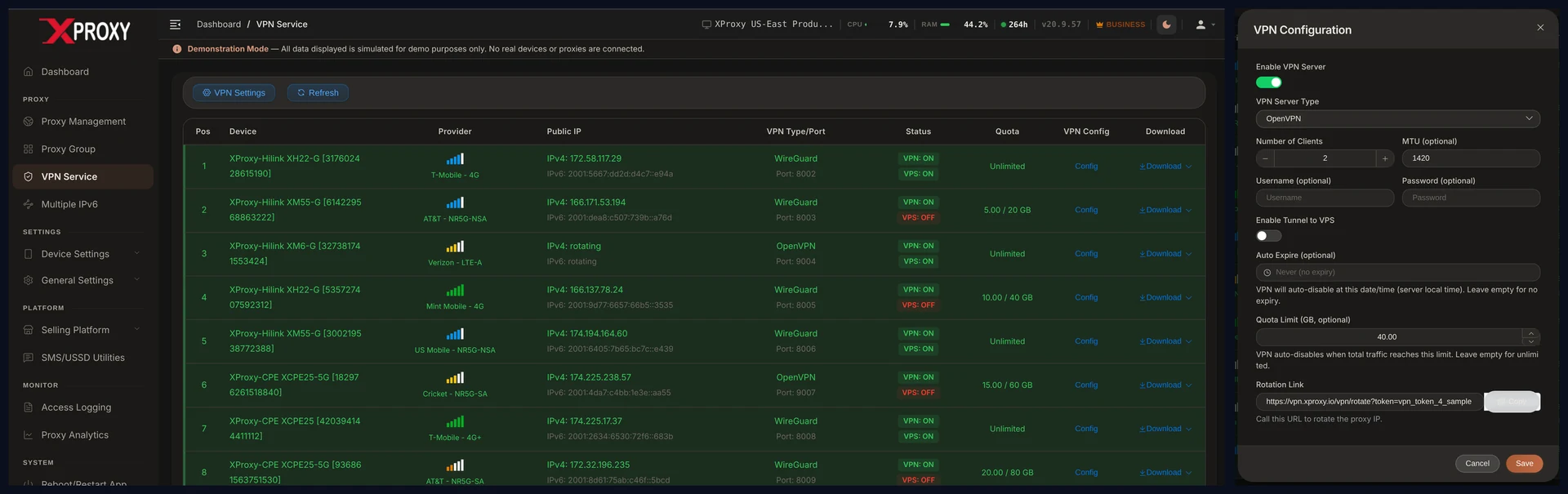
XProxy Dashboard Export Interface: OpenVPN Server Setup

XProxy OpenVPN Server Interface
🖼️ [ XProxy GUI Placeholder: OpenVPN Config Panel ]

Admin Panel -> OpenVPN Management (/admin/vpn/openvpn)

Protocol 05

5. WireGuard (Kernel TUN)

WireGuard is a high-performance VPN protocol running inside the Linux kernel, utilizing ChaCha20-Poly1305 cryptography.

Key Advantages
  • Kernel-space execution with minimal CPU overhead.
  • Fast connection negotiation (<100ms).
  • Full Layer 3 system routing (TCP, UDP, ICMP Ping).
Key Limitations
  • Single system interface: routes global OS traffic (cannot natively isolate 50 browser profiles).
  • Requires WireGuard client software installation.
Typical Use Case: Routing an entire computer's network traffic through a single 4G mobile SIM IP via 1-click WireGuard config.

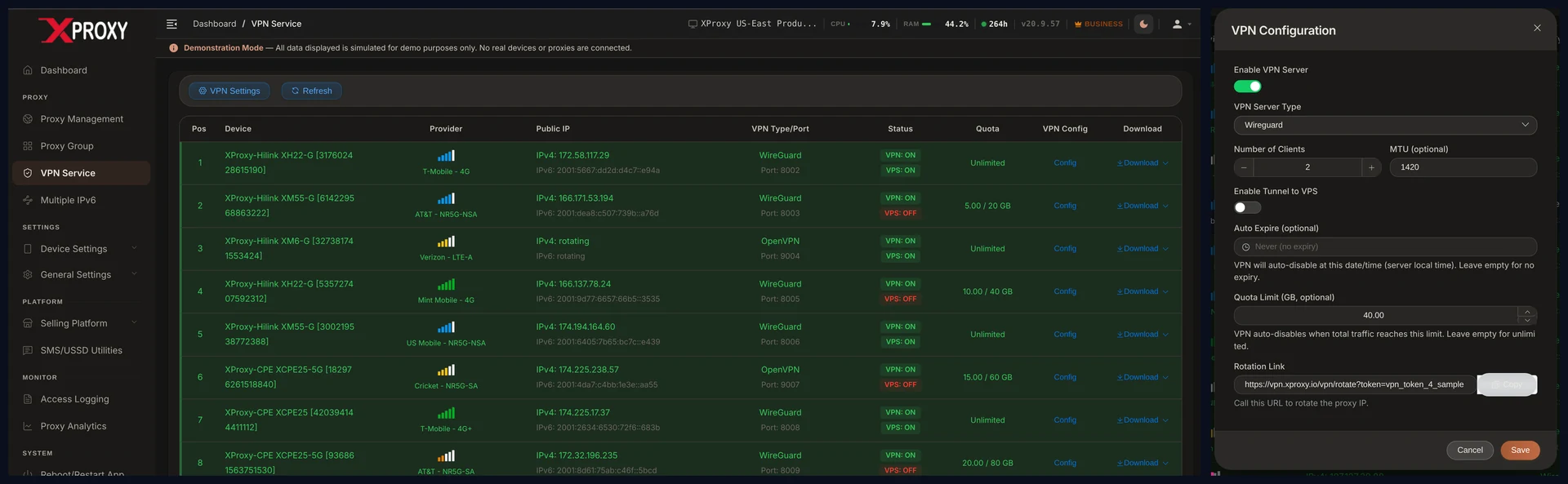
XProxy Dashboard Export Interface: WireGuard Configuration

XProxy WireGuard Server Management Interface
🖼️ [ XProxy GUI Placeholder: WireGuard Panel ]

Admin Panel -> WireGuard Server Management (/admin/vpn/wireguard)

Targeted Protocol Comparisons

Detailed technical comparisons for specific networking requirements.

HTTP vs SOCKS5 Proxies

Comparing HTTP web proxies vs SOCKS5 session proxies, authentication patterns, and scraping performance.

Read HTTP vs SOCKS5 ➔

SOCKS5 vs VLESS Protocol

Analyzing plaintext SOCKS5 limitations under Chromium UDP/QUIC drops vs VLESS TLS 1.3 encrypted tunneling.

Read SOCKS5 vs VLESS ➔

OpenVPN vs WireGuard

Comparing user-space OpenVPN with Linux kernel-space WireGuard performance on 4G/5G hardware servers.

Read OpenVPN vs WireGuard ➔
Telegram