
OpenVPN vs WireGuard: Mobile Proxy Benchmark
When system-wide OS network routing is required rather than browser-level proxying, Layer 3 VPN tunnels capture 100% of network traffic automatically. Here is how OpenVPN and WireGuard compare on XProxy cellular hardware nodes.
Why Layer 3 VPN Tunnels Differ from Proxies
Unlike SOCKS5 or HTTP proxies which rely on application-level support (e.g. browser settings), OpenVPN and WireGuard create virtual network interfaces (TUN) at the operating system level.
- Full OS Packet Routing: 100% of TCP, UDP, ICMP (Ping), and DNS queries route through the cellular modem automatically.
- Zero Application Friction: Desktop software, Discord, online games, and terminal scripts work immediately without proxy configuration.
- Single System Interface vs Multi-Profile Isolation: VPNs route 100% of OS traffic through a single interface/modem at a time. For multi-accounting with 50+ concurrent browser profiles across 50 different IPs, use SOCKS5 or VLESS proxies instead.
WireGuard vs OpenVPN Technical Matrix
WireGuard (Recommended)
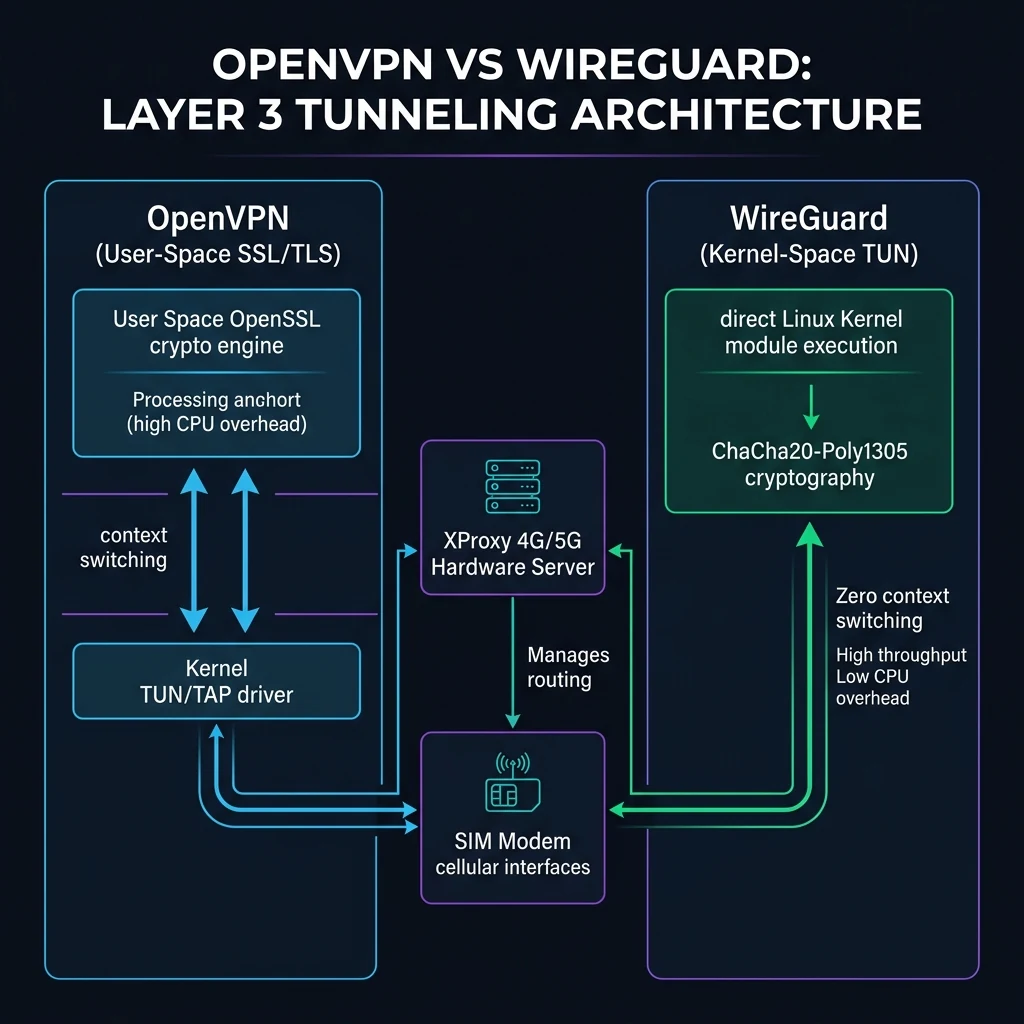
- Kernel Space: Executes directly inside Linux kernel space (~4,000 lines of clean code).
- Modern Crypto: Powered by ChaCha20-Poly1305 and Noise protocol handshake.
- Throughput: Up to 3x higher throughput with <10% CPU overhead.
- Handshake: Instant connection establishing in <100ms.
OpenVPN (Legacy Enterprise)
- User Space: Operates in user space with OpenSSL stack (~100,000 lines of code).
- Legacy Crypto: AES-256-GCM / OpenSSL cipher suite options.
- Performance: Higher CPU overhead on multi-modem hardware servers.
- Use Case: Ideal for legacy enterprise firewalls requiring TLS auth certificates.
XProxy Dashboard VPN Configuration Interfaces
OpenVPN Server Setup & Config Download
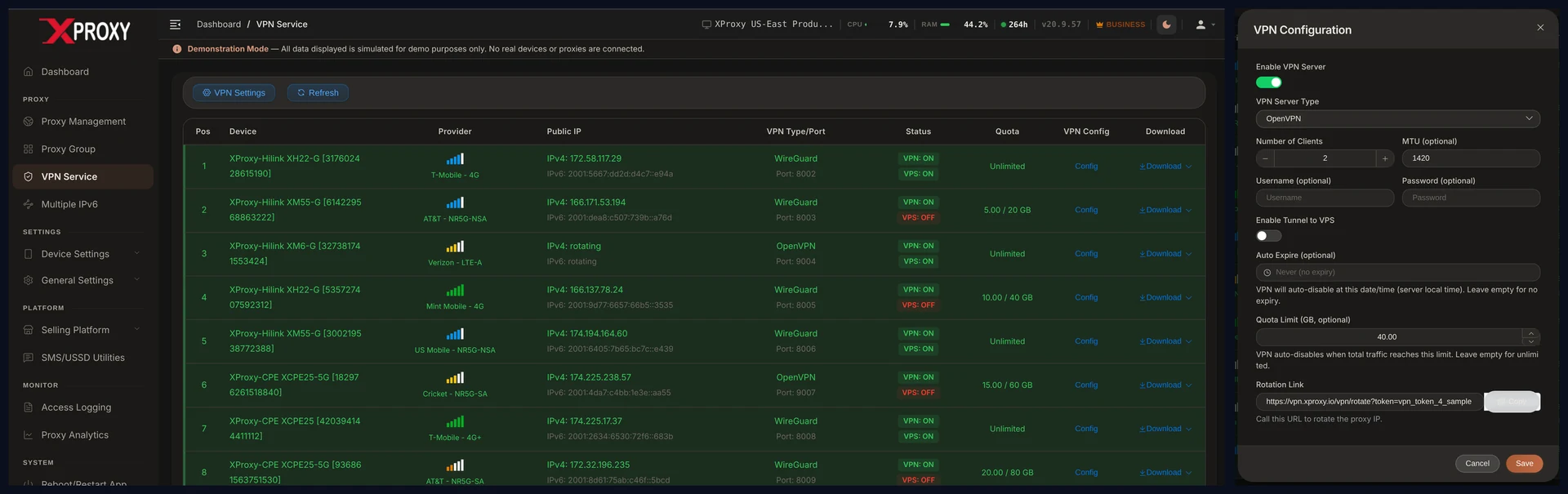
WireGuard Server Setup & Config Download
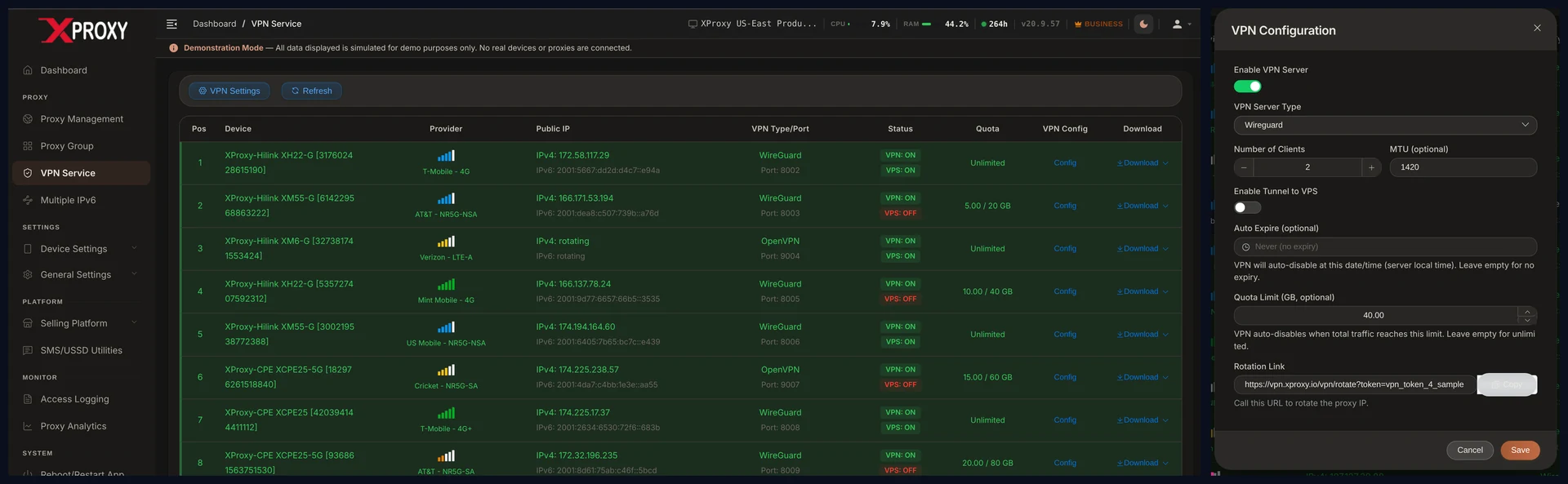
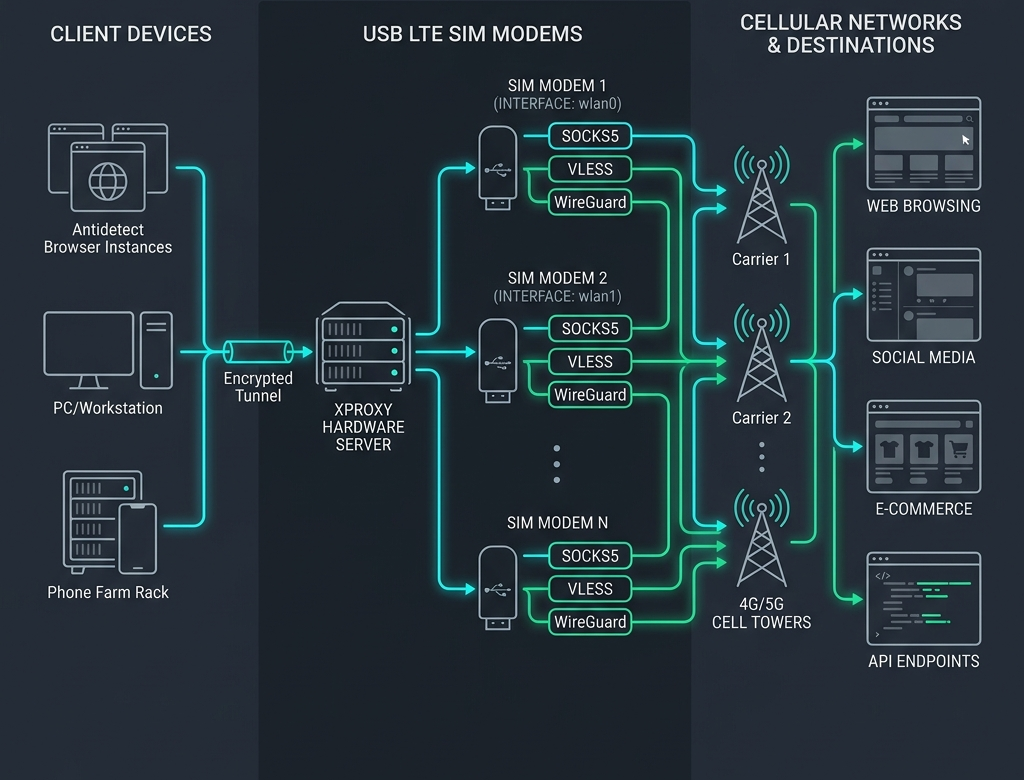
How It Works: Hardware Routing & Per-SIM Modem Protocols
XProxy provisions dedicated protocol endpoints per 4G/5G SIM modem interface out-of-the-box. Each modem plugged into XProxy gets its own isolated WireGuard TUN file, OpenVPN profile, and SOCKS5/VLESS endpoints, ensuring clean IP isolation per modem.
Layer 3 Network Tunneling (WireGuard / OpenVPN TUN Interface)
Visual representation of Layer 3 TUN kernel interface vs application-level proxies.
XProxy Generates WireGuard & OpenVPN Per Modem
Download ready-to-use WireGuard and OpenVPN configuration files directly per modem from your XProxy dashboard.
