
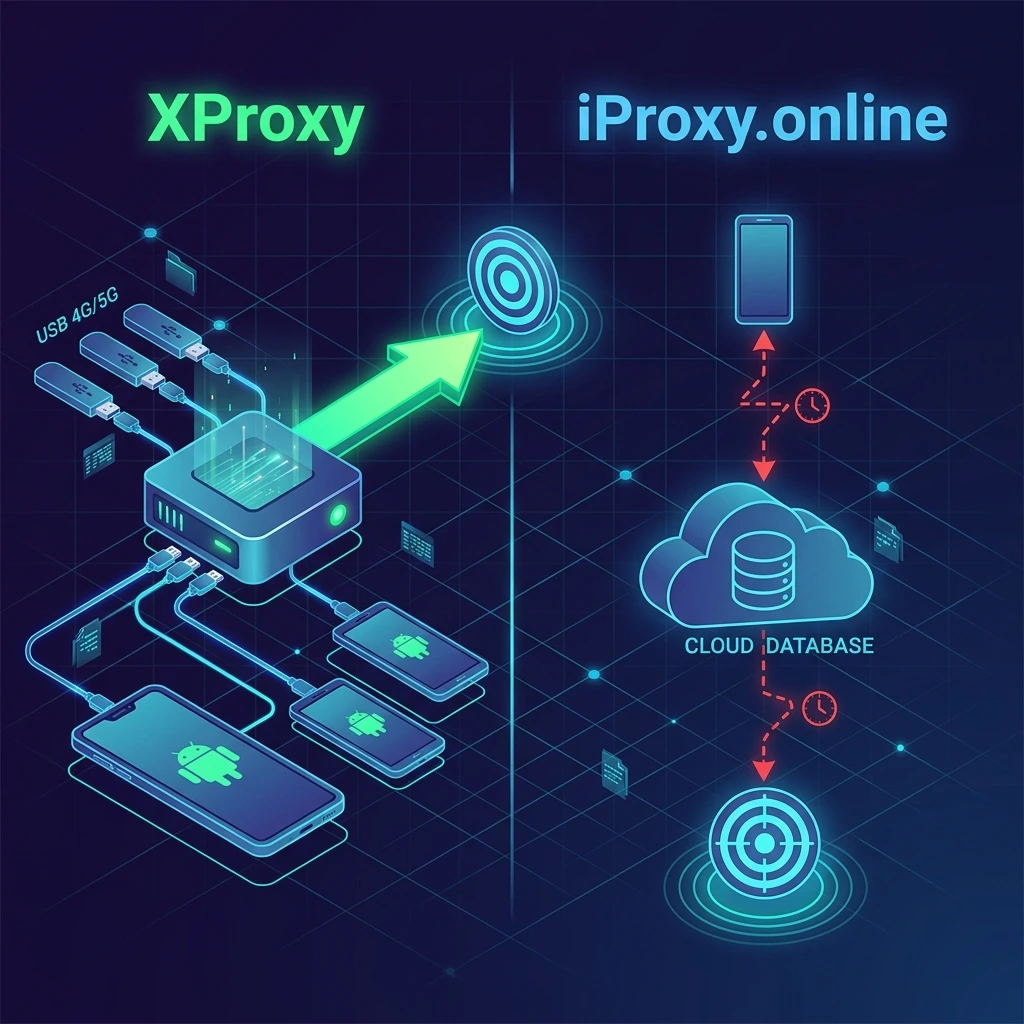
Full Direct Speed & Ultra-Low Ping
iProxy limits bandwidth (capped at 30 Mbps on their Basic plan) and routes all traffic through cloud servers, adding 100ms–300ms of latency (ping). XProxy runs 100% locally, routing connections directly from your SIM card for maximum carrier speed and zero cloud latency overhead.
Flat-Rate Pricing (Save up to 85%)
iProxy charges a recurring monthly fee per device ($6 to $10/mo per phone), which scales costs rapidly as you grow. XProxy offers flat-rate annual or lifetime licensing regardless of your traffic volume or device counts—cutting software costs by up to 85% for large-scale operations.
Complete Hardware & DIY Freedom
iProxy limits you strictly to Android phones with no hardware products. XProxy offers ready-made, premium hardware kits (similar to Proxidize) for plug-and-play ease, while also giving you 100% DIY freedom to self-build using standard USB modems (ZTE, Huawei, Alcatel) and any Linux server or mini PC.
100% Data Privacy & Security
Avoid sending your sensitive scraping, social media, or ad verification traffic through a third-party cloud. XProxy keeps your data fully private, running entirely on-premise on your local Linux machine.
Side-by-Side Comparison
Compare technical capabilities, cloud dependency, and licensing options between XProxy and iProxy.
| Feature / Capability | XProxy | iProxy.online |
|---|---|---|
| Licensing Model | Flat Annual / Lifetime Licenses | Monthly subscription per device/app |
| Traffic Routing Path | ✓ Direct local route (Direct SIM) | Routed through iProxy cloud servers |
| Latency & Ping | ✓ Ultra-low latency (Direct network) | Relay latency (routes traffic through cloud gateways) |
| Connection Protocols & VPN | ✓ Diverse (HTTP/3 QUIC, SOCKS5, VLESS, Shadowsocks, WireGuard, OpenVPN) | Standard (HTTP, SOCKS5, SOCKS5 UDP; OpenVPN & WireGuard configs on Pro plan) |
| USB Dongle / Modem Support | ✓ Yes (Huawei, ZTE, Quectel, etc.) | No (Supports Android devices only; modems are not supported) |
| Android Phone Support | ✓ Yes (Multiple modes: USB Forwarding, LAN/WiFi, and USB Tethering; rooted & non-rooted devices) | ✓ Yes (Via iProxy Android app; requires active app running on phone) |
| TCP OS Fingerprinting (p0f) | ✓ Deep Customization (Spoof iOS, Android, macOS, Windows; extract & clone real device signatures) | ✓ Passive OS Spoofing (Preset OS profiles: Windows, Android, macOS, iOS) |
| Bandwidth & Rotation Caps | ✓ Unlimited (No speed caps or bandwidth limits) | Speed capped at 30 Mbps on Basic plan; unlimited on Pro plan |
| Cloud Independence | ✓ 100% Offline (No cloud dependency) | Cloud connection required for app dashboard and routing; depends on their cloud servers |
The Real Cost Comparison: XProxy vs. iProxy
A realistic analysis comparing XProxy (DIY hardware + software license) against iProxy's cloud subscriptions (updated as of 2026).
| Scale | XProxy Software | iProxy.online Software | Savings |
|---|---|---|---|
5 Ports Starter | (Flat annual rate) | $750/yr ($12.5/mo per device) | Save $601 80% Flat-rate annual licensing |
10 Ports Growing Farm | (Flat annual rate) | $1,500/yr ($12.5/mo per device) | Save $1,351 90% Flat-rate annual licensing |
40 Ports Professional | (Flat annual rate) | $6,000/yr ($12.5/mo per device) | Save $5,701 95% Flat-rate annual licensing |
100+ Ports Enterprise | (Flat annual rate) | $15,000/yr ($12.5/mo per device) | Save $14,401 96% Flat-rate annual licensing |
Understanding the Pricing Models
iProxy.online operates on a recurring per-device model (ranging from approximately $6 to $12.50 per 30 days per mobile device). XProxy offers flat-rate annual or lifetime licensing based on modem/device counts. Because both platforms require you to supply your own mobile hardware and cellular carrier plans, the primary software difference lies in the subscription model: recurring per-device billing vs. centralized flat-rate licensing.
Frequently Asked Questions
Everything you need to know about switching from iProxy to XProxy.
Can I use my existing Android phones with XProxy?
Yes, you can. Instead of using the iProxy APK app, you connect your Android phones to a Linux server/PC via USB and enable standard USB Tethering. XProxy will automatically pick up the interfaces, perform IP rotations, and serve them as individual proxy ports.
How does the network latency differ?
With iProxy, your client requests go to iProxy cloud servers first, which route them to your Android device, receive responses, and route them back. This cloud relay adds roughly 100ms to 300ms of latency. XProxy works locally: the proxy endpoints are hosted directly on your server, making connections near-instant (only dependent on the cellular carrier speed).
Is XProxy difficult to set up compared to iProxy?
While iProxy is a simple app install, XProxy requires running a single commands string on a Linux system. However, once installed, XProxy auto-detects devices and runs entirely locally. It eliminates the need to configure cloud accounts, OpenVPN profiles, or deal with cloud disconnects.
Legal Disclaimer: XProxy is an independent software provider. All competitor product names, logos, brands, and trademarks (including Proxidize, iProxy.online, Oxylabs, Bright Data, and IPRoyal) referenced on this website are the property of their respective trademark holders. These trademark holders are not affiliated with XProxy, our products, or our website, and they do not sponsor, endorse, or authorize our software or comparison data.
This comparison is provided for informational and educational purposes only to assist customers in evaluating alternative solutions. While we make every effort to ensure the accuracy, completeness, and timeliness of the comparison data, the pricing structures, features, and terms of service of competitor products are subject to change at any time without notice. All data is provided "as is" and should be verified directly with the respective providers.
